
Siog Moore: A Life Where Motherhood Became the Beginning of a Career
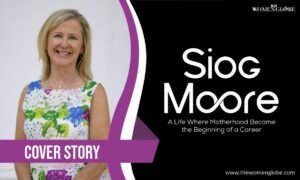
Where motherhood, observation and curiosity formed a 30-year leadership journey.
Early Years education can easily become adult-centred. There are milestones to follow, skills to develop and routines to manage. Somewhere in all of that, one simple question can slip away: what does this actually feel like for the child?
For Siog Moore, that way of thinking began long before she entered education. Irish by birth, she grew up with enormous respect for motherhood as work in itself. She always felt she was born to be a mother first and have a career later, an idea shaped strongly by her own mother.
Her mother was, and still is, an extraordinary woman: an organiser, strategist, dressmaker, artist, decorator, creator and an amazing chef. But perhaps the greatest measure of her success can be seen today. At 88, with seven grown children, she is in touch with most of them every day, and rarely a weekend passes without one of them coming to see her.
For Siog, there is something profound in that. A successful childhood is not only about the child you raise; perhaps, many years later, it can also be seen in the relationship that remains.
That understanding stayed with her as her own life took form. Siog became a nurse, a mother of four and an Early Years educator. In 1994, she opened Little Land Nursery and Montessori Centre in Dubai, bringing her professional experience and her understanding of motherhood into the work she had chosen for herself. In a rather lovely way, her passion for motherhood had become her career.
More than 30 years later, she is still learning, questioning and changing her mind. In 2025, after a workshop at Melonie Kariem’s inaugural Let’s Talk Early Years event, Siog was invited back onto the stage and thanked for her contribution to Early Years in Dubai as one of its “mothers”. The words touched her enormously. Motherhood was never something she put aside to have a career. In many ways, it became the beginning of one.
Where Little Land Began
The earliest years are filled with experiences adults can easily overlook, while families make important decisions about who will care for their children and what those environments should feel like.
The story began with two mothers.
A teacher living in Siog’s compound came to her with her baby because Siog was a neonatal nurse. They became firm friends and talked constantly about what they wanted from a nursery: communication, trust and a genuine understanding of what their children experienced when they were not there.
While visiting nurseries, Siog found herself looking at them from the child’s perspective. Were activities created because children needed them, or because adults liked how they looked? Were staffing decisions based on children’s relationships or adult convenience?
Eventually, they found a villa in Jumeirah, knocked down walls, refurbished it on a shoestring and opened Little Land.
She did not set out to transform Early Years education. She simply kept asking: Could this be better for the child?
When the Work Was Recognised
What began in a Jumeirah villa on a shoestring would, over time, receive recognition far beyond its beginnings. For Siog, who has spent much of her career questioning, reflecting and wondering whether she could do things better, that recognition has meant more than she might once have expected.
Little Land has received significant recognition over the years, including being named Best Nursery in the UAE by SchoolsCompared and WhichSchoolAdvisor. In 2025 came a particularly important moment: Little Land was named Setting of the Year by Montessori Global Education. After more than three decades of quietly developing, questioning and refining the work, that recognition meant an enormous amount to Siog.
Then, in 2026, came something different again: Most Loved Independent Nursery at the Mother, Baby & Child Awards, voted for by parents.
The awards are not why Siog does the work. But they have helped her, after years of looking for what could be better, to occasionally look at what she and her team have built and acknowledge that some of it is very good indeed. The more interesting story, though, is what she learned along the way.
What Nursing and Motherhood Taught Her
Healthcare teaches a particular kind of attention: noticing what is said, what is left unsaid and what may be communicated through behaviour.
Nursing taught Siog to observe. A baby cannot tell you what is wrong, so she learned to notice tiny changes. She learned that behaviour communicates something, that families matter enormously and that trust requires honesty.
Motherhood challenged her differently.
She was probably overprotective and believed it was her job to keep her children happy. An experience involving one of her children eventually led her to seek the help of a psychologist. She chooses not to share the details, not because they are simply difficult to tell, but because they belong to her child’s story as much as her own.
What the psychologist told her surprised her. She did not need to see the child. She could work with Siog, and all would be well.
What Siog learned through that experience was extraordinary. It introduced her to the work of Adele Faber and Elaine Mazlish and changed the way she understood parenting: accepting a child’s feelings does not mean accepting every behaviour, and an adult does not always have to make an uncomfortable feeling disappear. She has continued to share those ideas with parents, educators and her wider community.
Today, when a child is angry or distressed, she wants them to feel seen and accepted without shame or humiliation. Her questions are more likely to be: What is the need? How can I help? Who might I need to help me?
There is a practical lesson in that which has stayed with her: before trying to change the child, be willing to look at what the adult can change.
What Stayed and What Changed
More than three decades can change an industry considerably. Research develops and approaches evolve, yet some beliefs become stronger because they have been tested over time.
At Little Land, the practices have evolved, but the principles remain: presence, relationship, dignity, honesty and the child’s experience. The nursery remains screen-free. It does not use parent apps that require educators to spend children’s time documenting children for adults. Care routines are not considered lesser work; changing a child can be important one-to-one time with an educator. The team also tells parents the truth as they understand it, including when they make mistakes.
More recently, she has found herself questioning even the idea of happiness. If happiness simply means ease — everything going well, nothing uncomfortable, nothing too difficult — is that really what adults want for children?
She would rather see a child challenged, motivated, curious and excited; experiencing joy when something good happens or when something difficult finally works, while also discovering that frustration, disappointment and effort are things they can move through.
A child can remain sad, angry or disappointed and still have been beautifully supported. Supporting them does not mean removing every uncomfortable feeling. Sometimes it means staying alongside them while they discover: I can manage this.
The Quiet Work of Building Confidence
Confidence is often recognised through visible signs: a child speaks up, completes something independently or responds to praise. But early confidence can be quieter than what an adult sees from the outside.
One of the most important things Siog learned as a parent was Special Time: the child chooses what they do and the adult enters their world without correcting, directing or turning the moment into a lesson.
The message from the adult is beautifully simple: Being with you and entering your world is worth my time.
And what the child begins to feel is: I am worthy, just because I am me.
Children can be surrounded by “good girl”, “clever boy”, “amazing” and “well done” while inadvertently learning to look outside themselves to discover whether they are good enough.
Siog wants something quieter and more durable: My ideas matter. I can choose. I can try. I can struggle. I can get it wrong. I can ask for help. I can try again.
For her, self-esteem is not the belief that everybody thinks a child is wonderful. It is the knowledge that I have value, even when nobody is applauding.
Keeping Technology in Its Place
Technology is now part of childhood, while young children are still learning through movement, touch, relationships and direct encounters with the world.
Being screen-free does not mean being technology-free. Siog is actually very excited by technology and by what it may make possible.
If a child is interested in a caterpillar, they do not immediately need a video. At Little Land, children have books and models, find butterflies outside and have even raised silkworms to observe transformation themselves. The Montessori prepared environment allows curiosity to lead learning.
AI is already part of how Little Land works behind the scenes, and Siog can imagine extraordinary possibilities ahead. But technology should expand children’s experiences rather than replace richer physical, sensory and human ones.
Her preference is to prepare the thinker for the technology rather than prepare the child for a particular piece of technology.
Bringing Parents into the Picture
Parents and educators see a child from different positions. Educators observe them in a learning environment; parents carry years of experiences, routines and memories. A useful relationship needs space for both perspectives.
Parents first need to know that Little Land loves and values their child and is not judging them.
When something concerns the team, being right is not enough. They need to bring the family with them: share what they observe, listen to what the parents see and ask: What might this child need, and who might help us understand that better?
Parenting sessions have also taught Siog the value of community. Sometimes the most reassuring thing a parent hears is another parent saying, “We have that too.” When people do not feel judged, they can become curious.
That relationship with families means enormously to the team, and it depends in turn on the adults who spend their days with the children.
The team may know child development, but parents know their child in a way educators never can. They need both.
Looking Beyond the CV
Early Years education asks something particular of adults. Their decisions are often made in small, everyday moments that cannot be captured by qualifications alone.
A CV can be as thick as an encyclopaedia and still tell Siog surprisingly little about how somebody will relate to a child. If a candidate continually says, “At my previous nursery, we did…”, she brings the conversation back to the individual: “And what did you do?”
She asks practical questions about an upset child, biting, transitions and choice. Can this person wonder what may be behind behaviour? Can they guide without controlling? Can they stay curious when the easy response would be to judge?
Knowledge can be developed and skills practised, but the adult must first be willing to really see the child.
That willingness to keep seeing, questioning and learning has shaped Siog too. The more she has learned, the more questions she has found herself asking.
Becoming More Comfortable with Questions
The question of what Siog still wants to learn makes her laugh because her answer is: everything.
She wonders about everything. How can she do better? Is she asking the right question? Sometimes she asks herself: What is the question that might bring some light to this situation?
Alongside child-development knowledge, she believes leaders need self-awareness, emotional intelligence, reflective practice and communication. Educators cannot create emotionally secure environments for children without considering the adults providing them.
And now Siog is asking herself another leadership question: How do I step up by stepping back?
How does she transfer a culture so that the way people treat a child, parent or colleague does not depend on her being in the building?
After more than 30 years, learning has made her less certain, and she is comfortable with that. Certainty can close a conversation; curiosity leaves room to notice what you had not seen before.
Keeping the Child at the Centre of Every Decision
Through all that learning and change, one question has remained at the heart of Little Land. Leading an Early Years organisation means balancing decisions about children, staffing, finances, resources and the expectations of families and the wider industry.
When Siog considers something new, she often begins by asking: Are we already doing this another way? What will this genuinely add to the child’s experience?
Will it take an adult away from the children? Will it create unnecessary cost for families? If they put time, money or energy here, what might they not provide elsewhere?
She thinks about beautiful green grass in Dubai. It looks wonderful to an adult touring a nursery. But in full sun, can a child actually use it? Put it under shade and perhaps it will not remain quite as immaculate, but children can play there.
The question becomes: Is it designed for the child’s experience, or for the adult’s impression of the child’s experience?
Parents and educators can carry that question into ordinary moments. Is this activity for the child, or for the photograph? Am I helping because help is needed, or because I am uncomfortable watching them struggle?
Little Land must be financially sustainable. But commercial success enables the work; it cannot become the reason for the work.
Making Room for Different Strengths
That principle has shaped Siog’s leadership too. She understands that children are different, but does not always see the same understanding extended to adults.
One educator may be wonderfully creative and love mess and activity. Another may bring calm, structure and extraordinary attention to detail. The question is not which is better. It is: What happens when we put these people together?
Leadership is not about creating people who work like her, or like one another. It is about understanding people well enough to create conditions in which different strengths contribute to something shared.
Little Land prepares environments for children because development does not happen identically for everybody. Perhaps good leaders need to create prepared environments for adults too.
For Siog, leadership is increasingly less about being the person with the answer and more about building a culture in which others can think, contribute and take responsibility.
What Are We Really Measuring?
Early Childhood education produces many outcomes adults can see and measure: a child recognises a name, identifies a colour or gives the expected answer. Those moments can feel like progress.
Siog believes the deeper question is what the child is learning about themselves while those things are happening.
Sometimes at morning self-registration, an adult lovingly asks a young child to find their name. Before the child has enough time, the adult points to it, guides their hand and says, “Good girl. You’re so clever.” Everything is done with love. But what has the child learned?
Siog would rather begin with a choice: “Which colour highlighter would you like?” That tiny decision matters. It is the beginning of becoming a chooser. Then she would invite the child to find their name and make their mark. Wherever it lands: “Thank you.” Tomorrow brings another opportunity.
The goal is not to produce the correct answer and praise a child for producing it. It is to help children become thinkers, choosers and doers: to experience the joy of having an idea, trying it, discovering that it did not work and having another go – and then the particular joy when a new idea does work.
Siog does not want a child to need her applause in order to know they are capable. She wants them to experience agency in small, ordinary ways.
What Should We Carry Forward?
Every generation enters a changing world. Technology evolves, information becomes easier to access and the ways people communicate shift. Early Years education therefore carries a larger responsibility: deciding what in human development should remain central regardless of what changes around it.
Children may grow up in a world where it is increasingly difficult to know what is real and what information to trust. They cannot be prepared simply by teaching today’s technology. They need to be prepared for the person who will encounter whatever comes next.
They need to think, choose, question, wonder and understand their values; to say, “I don’t know,” ask, “How could I find out?” and discover that being challenged is not the same as being unsafe or unhappy.
They also need community. Parents need it. Educators need it. Children need to experience belonging, contribution, disagreement, repair and the knowledge that other people matter.
Technology will change. We should change with it, question it and use what genuinely adds value. But Siog hopes we never become so impressed by what technology can do that we forget what only human beings can give one another.
Perhaps the question is not only: How do we prepare children for the future? It is: What is so fundamentally human that we want to make sure we carry it with us?
For Siog, that means connection, relationship, community and values. It brings her back to where the story began: to a mother of seven, now 88 and still deeply connected to the family she raised; and to the understanding that, in the end, what lasts may matter more than what impresses in the moment.